
Customers
Customers at the heart of all its actions
Published on
STIB plans to offer all its customers an efficient and pleasant overall mobility experience, by anticipating their expectations and accompanying them at every stage of their journey.
To do this, it ensures the growth and quality of the public transport offer and is at the heart of the development of new mobility services in Brussels.
2021 Barometer
Satisfied customers
7.3/10 customer satisfaction
STIB achieved a score of 7.3/10 in its satisfaction barometer for the second year in a row. This major survey, conducted annually by an independent research firm, allows STIB to take the pulse of its passengers so it can discover the sources of satisfaction, points of attention and customer priorities. Despite the increase in passenger numbers on its network compared to 2020, STIB is managing to keep its customers satisfied by maintaining a score of 7.3/10, which is a good improvement over the 7.1/10 score STIB received in 2019, before the health crisis. This result also brings STIB closer to its target of 7.4/10, which it aims to achieve by the end of its public service contract with the Region, which runs until the end of 2023.
In 2021, the top five customer priorities remained service frequency, comfort, punctuality, connections and, lastly, journey times. Contactless payment is a new service that is particularly popular with customers. This system was mainly aimed at occasional travellers and tourists. It finally also appeals to more regular passengers thanks to its ease of use. The prices are also appreciated and are considered affordable overall.
Travellers are paying more and more attention to the feeling of security. The health crisis has probably exacerbated its importance, if only because there was less traffic on the STIB network. There has also been a general increase in precariousness in society as a result of the health crisis, and this is obviously reflected in public transport’s infrastructure. STIB is working hand-in-hand with the non-profit sector to remedy this.
How is satisfaction measured?
The satisfaction barometer is carried out by an independent market research company (IPSOS) at the request of the Brussels-Capital Region. The last survey was conducted from 19 October 2021 to 25 January 2022 based on an online questionnaire and one by telephone. A total of 8,321 people participated in the surve: 6,104 online and 2,217 by telephone.
Passenger numbers
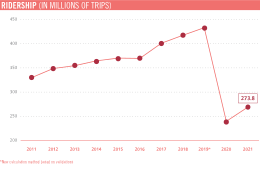
273.8 million journeys
Once again this year, STIB has had to show resilience, perseverance and creativity to continue to serve its customers and improve its offer, as well as contribute to Brussels life in the context of the health crisis. And its customers have returned the favour, as evidenced by the gradually increasing ridership throughout the year.
In total, STIB recorded 273.8 million journeys in 2021, which represents an increase of 12% compared to 2020, and 64% of the ridership recorded in 2019 (benchmark year for STIB).
Numbers have been gradually recovering since late 2020 and this upward trend has continued throughout 2021. At the beginning of January 2021, 57% of the 2019 level was reached, a figure that rose to 70% in December 2021, with peaks of 90% recorded on some Saturdays in December.

Distribution of journeys by mode
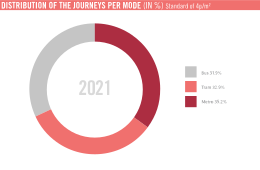
In 2021, the distribution of journeys was relatively even between the three modes, with the metro leading, followed by the tram and then the bus.
With the recovery in passenger numbers on the STIB network, all modes gained passengers compared to 2020, although the bus recorded the highest increase.

Kilometres travelled
New lines and new vehicles
More than 2 million km travelled by electric buses
In 2021, the metros, trams and buses covered a total of 50.6 million kilometres on the Brussels public transport network, which represents an increase of +9.7% compared to 2020.
The kilometre production went beyond its pre-COVID-19 level, thanks to the resumption of the Noctis network in July, the arrival of new vehicles and the creation of new lines on the STIB network.
By ensuring maximum frequency on all its lines, and even increasing it on the metro lines, STIB has enabled the people of Brussels and commuters on its network to have maximum space during their journeys. This is an essential factor in improving comfort on the STIB network, and one whose importance has become even greater in the health context.

Capacity
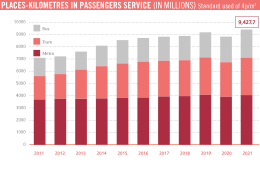
9.4 billion places-kilometres
The reception capacity of STIB's vehicles is calculated in places-kilometres. Places-kilometres represent the number of available seats across all metro trains, trams, and buses, multiplied by the number of kilometres they have travelled. This measurement is commonly used in the transport sector. This indicator counts not only available seats, but also the frequency of the vehicles. In 2021, STIB achieved a total of 9.4 billion places-kilometres on its network. This rise follows the increase in the number of vehicles, with the arrival of the new M7 trains, the delivery of additional hybrid buses, and the creation of new lines, with the continued implementation of the Bus Plan and the extension of tram line 9. The availability of new vehicles has enabled STIB to increase frequencies on several of its lines, which benefits its passengers. In particular, metro frequency has been increased on metro lines 2 and 6, with a 10% increase in peak capacity in November 2021, followed in early 2022 by a further capacity increase, with a total peak rise of 20% on lines 2 and 6.

STIB responds
"Without you, there would be no Brussels"
The company had to deal with an exceptional situation again this year. In this context, STIB continued to operate and its staff were present every day to continue to make Brussels live and move. STIB has also highlighted this message in its new brand signature: "Together, let's get Brussels moving".
Ensuring maximum frequency on its lines, ensuring the intensive cleaning of vehicles, and also offering free travel to vaccination centres and organising vaccinations for its staff... STIB has never stopped looking after the safety and well-being of its customers and staff. In 2021, STIB's campaigns highlighted the extraordinary work of its staff and encouraged passengers to return to public transport.
STIB's "Get Back" campaign invited its passengers to reconnect with cultural and festive life in Brussels by using public transport. It hummed "c'est si bon" (it's so good), made them dance to piano music in the metro, showed them the light at the end of the tunnel, gave them flowers and gifts, and more. It goes without saying that STIB pulled out all the stops to win back the hearts of its passengers in 2021.

Cleaning of vehicles
Since the beginning of the health crisis, STIB has been committed to its role as a public transport company, while protecting its passengers and staff. Cleaning before each journey on the network, additional cleaning rounds at terminals, disinfection of contact areas and more. As it explains on its blog, STIB invested an additional 22.5 million euros in 2021 to enhance the cleaning of vehicles and stations.
Free STIB to vaccination centres
People invited to be vaccinated in Brussels were offered a free return journey. In this way, STIB supported the vaccination campaign in Brussels, which was an important part of the government's strategy to fight COVID-19.
A campaign to say "thank you"
STIB started 2021 by honouring its employees through a campaign designed to thank them for their investment, their commitment, the service they give to passengers and their tenacity in the difficult and unprecedented context of the health crisis.

Get Back campaign
STIB launched a major "Get Back" campaign to win back the hearts of travellers and encourage them to return to public transport. This campaign was divided into several actions, during which STIB pulled out all the stops to win back its customers. The campaign began with a song: "c’est si bon". Launched when the warm weather returned, it invited Brussels residents and visitors to bring Brussels back to life with STIB, through various themes introduced by "c’est si bon". Examples of these themes are "inviting your friends to your huge garden", "saying 'go on, one more for the road'" or "being able to enjoy your favourite restaurants".
STIB brought to life the expression "the light at the end of the tunnel". By playing with light, it wanted to celebrate with its travellers the gradual return to a more normal life. This action assumed the national colours during Euro 2021 to support the national football team, before taking on orange summer hues. The installation could be seen in the metro tunnel between Parc and Arts-Loi stations between June and September 2021, during which time STIB recorded 3.7 million journeys between these stations.
But that's not all. To thank its passengers, STIB distributed flowers and sang to them accompanied by piano tunes in the metro. Actions were carried out in collaboration with the shops in the stations, which offered scratch-off coupons. The campaign also included a B2B component, through a unique collaboration with five major Brussels partner employers such as RTBF and VUB.
Different travel packages
An innovative buying experience
35% of the tickets issued paid contactless
The quality of the service offered to travellers depends on all their interactions with STIB, during the journey, but also before and after. The buying experience is an important link in this chain. This is why STIB is constantly innovating to make purchasing its tickets easier.
In July 2021, contactless payment celebrated its first birthday and counted already over 2 million validations. By the end of 2021, this figure had risen to 3.6 million and contactless payment represented 35% of the 1 journey tickets issued. These results significantly exceeded projections. We can conclude that this new payment method is not only appreciated by occasional travellers or tourists, but has also been adopted by many other customers.
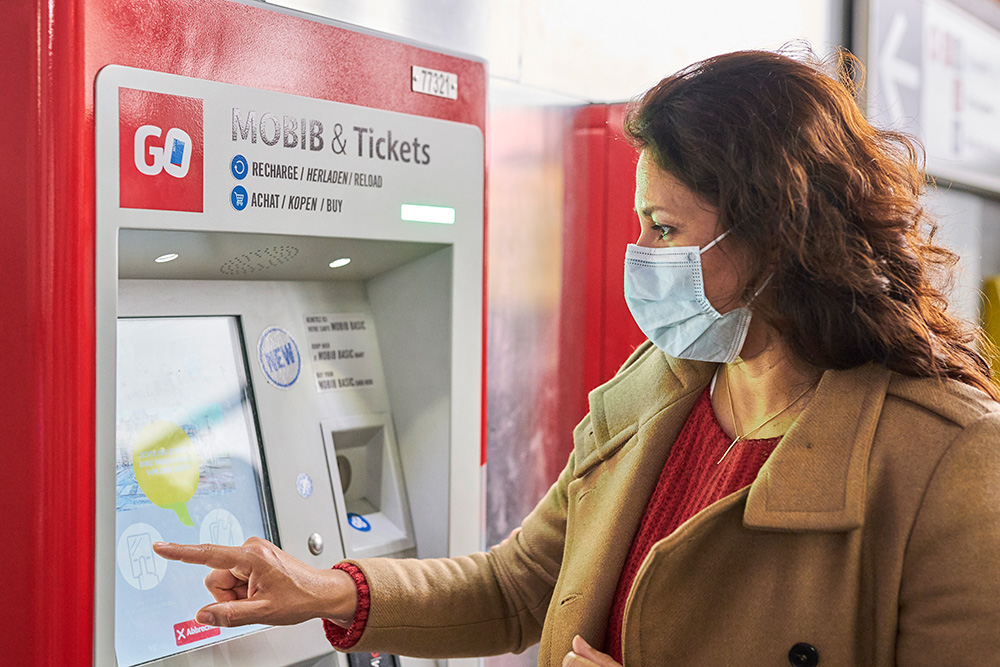
GO vending machines remain the preferred sales channel for all travellers. In 2021, STIB completed the replacement of its old vending machines with new, more modern and user-friendly models. New features: they are equipped with touch screens and the "full" models provide MOBIB basic cards.
2021 saw the arrival of new pricing formulas: Brupass and Brupass XL. The Brupass was formerly known as the MTB or JUMP and the Brupass XL is its extended version eagerly awaited by travellers in the Brussels suburbs. The school pass was reduced from 50 to 12 euros, to encourage young people to use public transport even more.
3.6 million contactless validations
Contactless payment has already been validated more than 2 million times after just one year. By the end of 2021, this figure had risen to 3.6 million, reflecting the popularity of this new formula, which is mainly intended for occasional travellers and tourists.
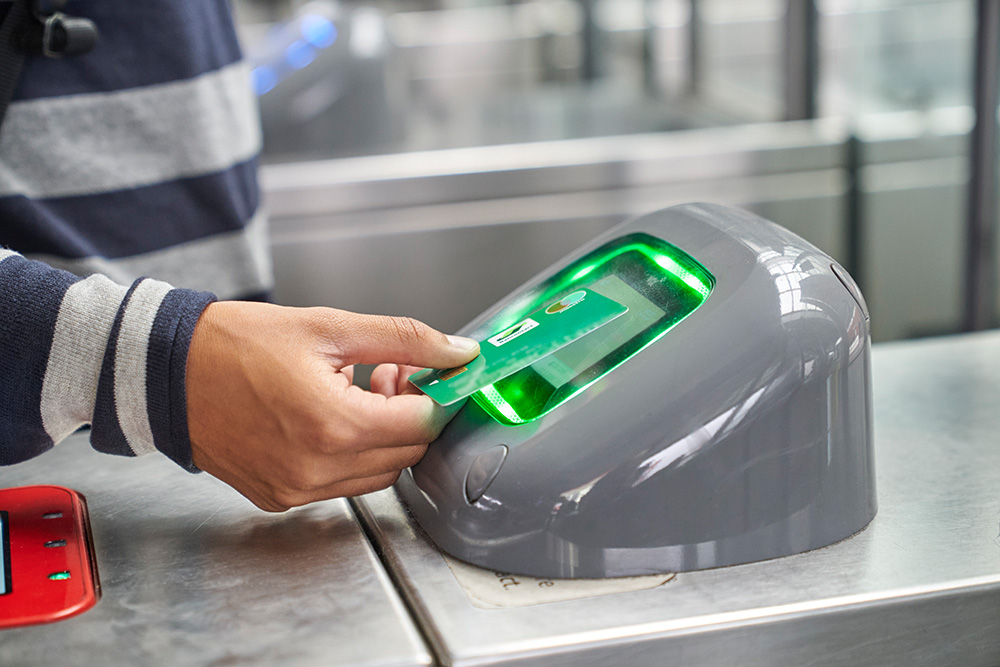
The new grey and blue validators at gates and in vehicles mean that there is no need to buy a ticket in advance. Travellers simply have to wave a contactless bank or credit card or a connected device (smartphone, smartwatch) in front of the validator, and off they go. At the end of the day, the system calculates the price for the day's journeys, with a limit corresponding to the price of the 1-day ticket. This way, customers can be sure that they never pay more than necessary.
The school pass was reduced to 12 euros
On 1 July, the school pass was reduced from 50 to 12 euros. It allows young people in education up to the age of 24 to travel throughout the year on the entire STIB network (except from Brussels Airport) for only 1 euro per month.
This subscription enjoys a volume discount, as the first and second cost 12 euros but there is no charge from the third pass purchased within the same family. It also exists as a "Brupass" formula, for an additional 40 euros.
The aim of this measure is to make Brussels' public transport even more accessible and encourage even more young people to use STIB for their travel. After the reduction in the price of the school pass, a new step was taken in February 2022 with the creation of the "18-24 Bruxellois" pass. This allows young people in Brussels to purchase a pass at 12 euros per year until they are 25, whether or not they are in education.

The Brupass XL is born
On 1 February 2021, the JUMP and MTB intermodal passes became the "Brupass". They allow passengers to use the lines of the other Belgian transport operators (SNCB, De Lijn and TEC) in addition to the STIB network within an area corresponding to the Brussels-Capital Region.
The big news for 2021 was the arrival of the Brupass XL. Like the Brupass, this ticket allows passengers to use the lines of STIB and other public transport operators without distinction. The difference is in the area of validity, which is larger and corresponds to an area of 11.5 km around the Grand-Place (i.e. Brussels and its immediate surroundings, with the exception of journeys from the airport). This extended area includes 53 train stations and 2,800 bus, tram and metro stops.
Brupass and Brupass XL tickets must be loaded onto a MOBIB card and are available in the form of 1- or 10-trip single tickets and monthly or annual season tickets. The Brupass is also available as a 1-day ticket.

Customer-focused information
STIB in the digital age
1.25 million downloads of the STIB app
In the age of digital technology and new modes of mobility, it is essential to have clear, up-to-date and relevant information, so passengers can travel around the capital as fluidly as possible. STIB has understood that digital services are essential for offering a quality service to its customers and contributing to their satisfaction. That's why it continues to evolve its mobile app, so it can better meet passenger needs.
STIB carries on with its pilot application MoveBrussels. This MaaS app, which stands for Mobility as a Service, integrates the services of STIB and other soft mobility operators. Whether in terms of application functionalities, partnerships or even the physical variation of the app on the network, the MoveBrussels app continued to evolve in 2021, gradually giving way to the version that will be offered to the public at the end of 2022.
Of course, we can't talk about digital technology without mentioning social media. While STIB started out quietly on Facebook around 10 years ago, it is now present on many different media and has tens of thousands of subscribers. Facebook, Twitter, LinkedIn, Instagram, YouTube and, since 2021, TikTok. People are always talking about STIB thanks to its open, customer-focused and slightly offbeat communication. It also regularly updates its blog STIB Stories and offers podcasts, which allow fans, enthusiasts and the curious to discover the Brussels transport company behind the scenes.

1.25 million downloads of the STIB app
Further improvements were made to the STIB mobile app in 2021, especially in terms of intermodality.
The stops of all public transport operators in Belgium (SNCB, De Lijn, TEC and, of course, STIB) as well as the stations of the shared mobility operators Villo!, Cambio and Collecto, are now included on the map.
The application has also had an "offline" mode since 2021. This feature allows passengers to continue to follow a route, even if they lose connection. Another small plus is that a message is displayed in the app when the device is not connected, which makes it easy to identify the problem if the connection is lost and so greatly facilitates the life of app users.
The result? STIB has reached 1.25 million downloads of its mobile app since its launch in October 2018.
MoveBrussels
In August 2020, STIB launched the pilot of its MaaS application MoveBrussels. In 2021, it continued to gather feedback from its users. This way, it can learn more about how they use the app and, more importantly, develop it.
New features have been introduced as well as improvements to the interface and user experience. One of the most striking features will probably be the ability to view taxi rides and their approximate price, and book rides with Taxis Verts directly in the app. STIB also entered into a new partnership with Poppy car-sharing. And it continues to refine the pilot in preparation for the app launch in the second half of 2022.
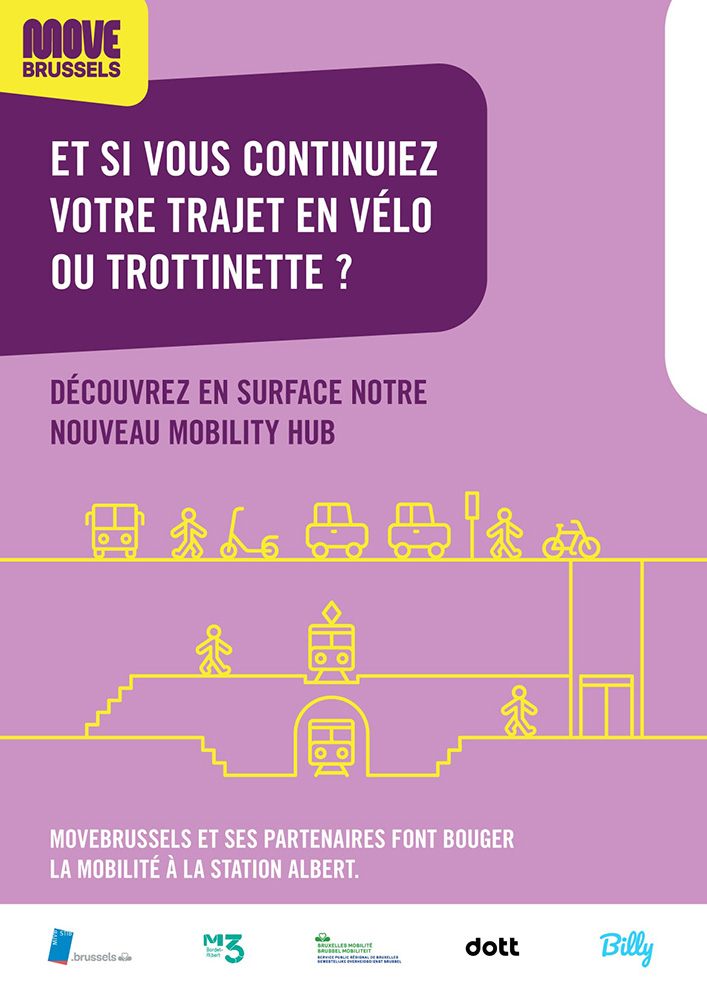
The first physical version of MaaS appeared on the STIB network in 2021. A Mobility Hub has been tested at Albert station. Users of the pre-metro station could find shared scooters and bicycles at all times to help them continue their journey.
STIB launches on TikTok
- Facebook: STIB Officiel: 97,351 fans +4% - MIVB Officieel: 8,922 fans +3%
- Twitter: @stibmivb: 138,979 followers +4%
- Instagram: @stibmivb: 16,633 followers +13% - @mivbstib: 2,534 followers +23%
- LinkedIn: STIB-MIVB: 23,283 followers +10%
After almost 10 years on social media, STIB remains on its toes. After Facebook, Twitter then Instagram, in October 2021 STIB launched on TikTok, to mark the presentation of the new TNG tram. It offers network news and offbeat videos. STIB always attracts viewers with its open and offbeat communication on social media. Its publications will not have gone unnoticed in 2021, whether they featured its staff, its vehicles, or trams disguised as French fries. Its blog, STIB Stories, is still very successful, with 140,096 visits and 367,041 page views.

Support during works
Passengers, residents and traders at the heart of the projects
Albert station, Toots Thielemans, Neder-Over-Heembeek tram... These are large-scale projects which aim to improve mobility in the city, but involve major construction sites. This is why STIB is committed to involving and informing local residents and traders throughout the various phases of the projects.

A new station close to the Gare du Midi
Toots Thielemans is a brand new metro station, named after the famous Brussels jazz musician. Currently under construction, it will be located under avenue de Stalingrad and directly connected to Lemonnier station, providing an easy connection between the tram and the future metro line 3. At the end of 2021, the construction of Toots Thielemans station reached a crucial stage with the completion of the first part of the roof slab.
A number of supporting measures are planned to support the district during the construction of metro line 3: various information channels, physical contact points, support funds for traders, as well as actions to promote the district or co-create customised solutions. In 2021, a point of attention turned out to be the fight against illegal dumping. Solutions have been found, with the creation of dedicated collection points and the provision of additional supervisory staff.
The Stalingrad district is a lively area, with a wide and varied range of shops, which STIB and its partners are making sure to highlight despite the ongoing construction work. With this in mind, the lighting on the Palais du Midi façade has been improved to highlight this emblematic building. In addition, three murals on the theme of "women in the public space" were created under the railway bridge on avenue du Midi, through a participatory process.
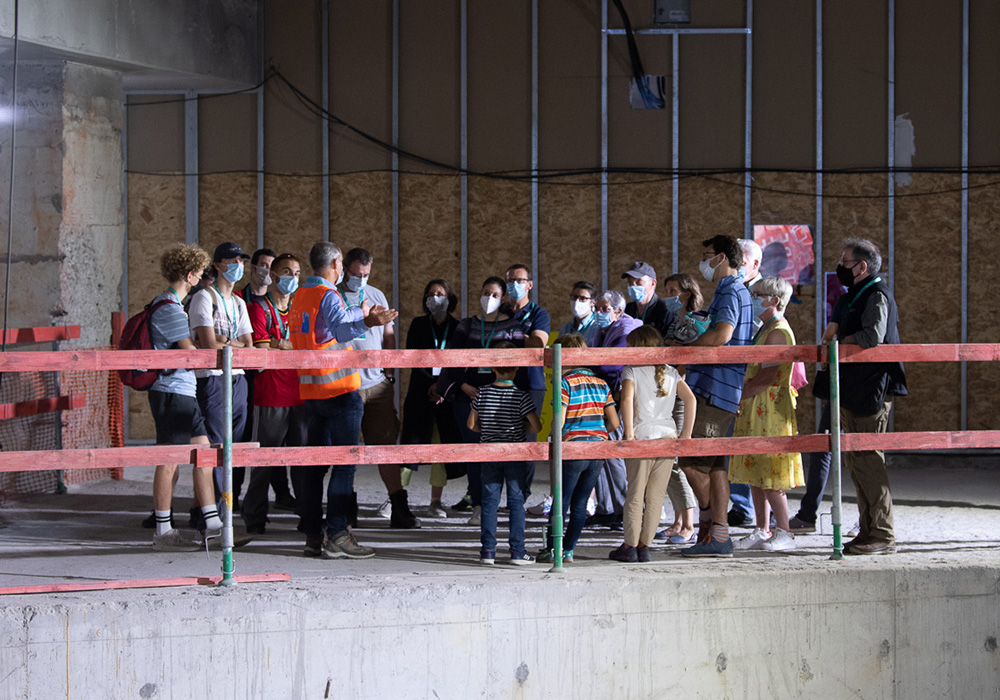
The Albert construction site open to the public
To mark the Mobility Week in September 2021, the Albert station construction site was opened to the public during the traditional open day. The terminus of the future metro line 3 has revealed all its secrets to visitors: a vast mezzanine, storage spaces behind the walls, long platforms, a wide-gauge tunnel... Although Albert station was originally intended to house a metro, the work that is taking place there is still on a large scale. It aims to transform the station into a large, modern and user-friendly multimodal hub, allowing people to switch comfortably from the tram to the metro.
Albert station will eventually be a new terminus for trams 4 and 51 on the one hand and for metro 3 on the other. It is therefore necessary to raise the platforms and install the equipment necessary for the future passage of the metro. A total of five lifts will be installed in the station, as well as a secure bicycle parking area.
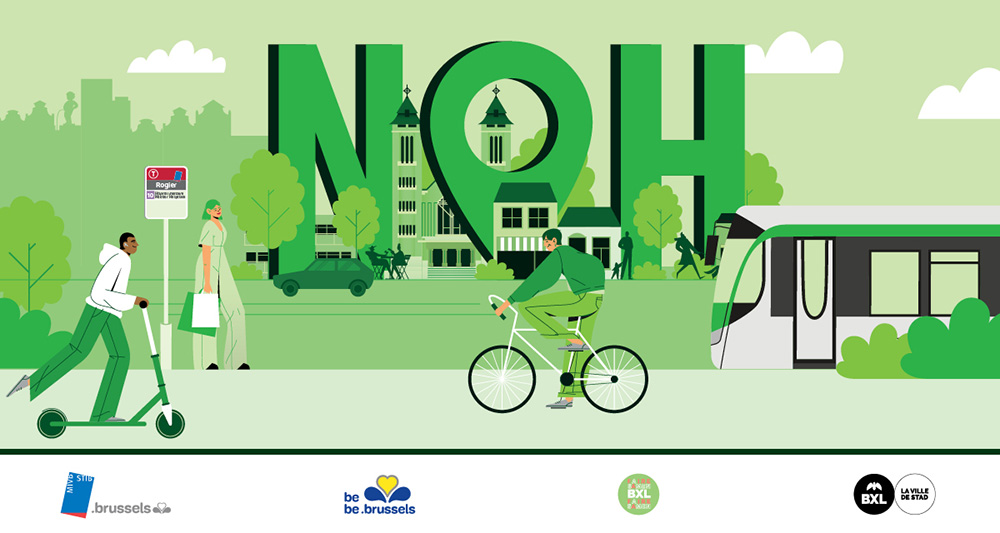
Citizen participation at the heart of the NOH tram project
After the impact study and the approval of the route and the mode of transport by the regional and municipal authorities in February 2020, the tram project in Neder-Over-Heembeek took another decisive step at the end of 2021 with the submission of the planning application.
Citizen consultation is central to this project. The proposed plans are the result of an 18-month process, during which citizens, traders and businesses located near the Tram 10 project were able to share their requests. This approach led to an increase in the number of parking spaces, for example.
The start of work not related to the planning application, such as utilities, is planned for spring 2022 and the first track laying in late 2022 – early 2023. The 5.5 km route will ultimately provide a fast and direct connection between the city centre (Rogier) and Neder-Over-Heembeek.
Next chapter
-
Company
The STIB is a dynamic, innovative and efficient company.